Introduction
In the late nineties, while working for the Danish International Development Agency (Danida), I witnessed a significant shift in India’s economic policies. The country began transitioning from a predominantly socialist framework to a more open market model, introducing concepts like cost recovery even in essential services such as water supply and sanitation. This transformation has been gradual and continues to evolve, slowed by political hesitancy and economic challenges.
During my tenure with Danida, I was responsible for rural water supply and sanitation projects implemented on a demand-driven, participatory basis. Our approach engaged end users from conception to operation, utilizing governance structures like the Gram Panchayat and building local capacities at the most appropriate level to ensure sustainability. My experiences in Karnataka and Tamil Nadu reshaped many of my preconceived notions. I learned that communities are willing to take ownership and contribute to cost recovery, provided they are involved and trained in managing these assets.
Around this time, Public-Private Partnership (PPP) models were being introduced in India. However, unlike in the energy sector, they struggled to gain traction in water management due to political resistance and the long-held belief that water, as a natural resource, is a universal right. While I agree that natural water is free, the water delivered through infrastructure—encompassing storage, conveyance, distribution, and delivery—comes at a cost.
India’s water supply challenges are vast and complex. Government data reveals that over 70% of India’s water is contaminated, and only 50% of the population has access to safe drinking water. The Jal Jeevan Mission (Har Ghar Jal), launched in 2019, aims to provide tap water connections to every household by 2024. Covering 192 million households, this mission focuses on delivering reliable, safe, and sustainable water.
The public sector has traditionally managed water services in India, but challenges like aging infrastructure, resource mismanagement, and water pollution necessitate the exploration of PPPs. These models, however, must account for regional differences and the socio-economic realities of a country where 68% of the population lives in rural areas and poverty remains a significant barrier.
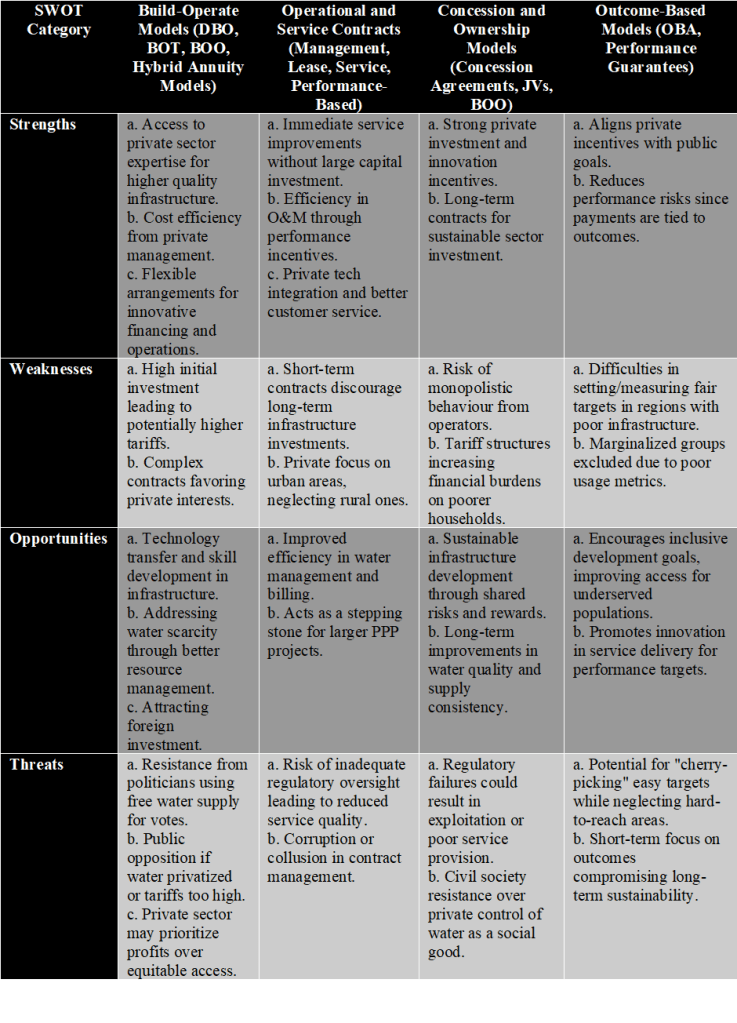
In this blog, we will conduct a SWOT analysis of various PPP models and explore their applicability across different water supply sectors, including metros, Tier 2 cities, regional water supply schemes, and rural areas.
Categorising different types of PPP and SWOT analysis
In the first step, let’s try to categorize the various Public-Private Partnership (PPP) models in the context of water supply and sanitation in India, we can group them into a few distinct categories. Following this, a SWOT analysis can help assess their strengths, weaknesses, opportunities, and threats, while keeping in mind the socio-economic realities of India, such as most of the population being poor, water being a social good, and the primary motivation behind water projects being public health rather than profit.
Contextual Considerations for India
- Majority of Population is Poor:
- Tariff-based models (e.g., BOT, BOO) may lead to higher costs for consumers, making water less affordable for the poor.
- Subsidy-based models or OBA could provide financial support for vulnerable populations but require robust government oversight and management.
- Water as a Social Good:
- There is a risk of treating water as a commodity rather than a right, especially in concession-based models.
- Models need to balance private incentives with public interest to ensure water remains accessible and affordable for all.
- Health and Hygiene over Business:
- Performance-based models, especially in sanitation and clean water access, can align with public health goals by focusing on outcomes like reducing waterborne diseases.
- Long-term, sustainable investments in water and sewage infrastructure through joint ventures or annuity-based models can contribute significantly to improving health outcomes.
Suitability of PPP in Different Settings in India
This section evaluates various types of Public-Private Partnership (PPP) models in water supply schemes across different settings in India, including Metros, slums and unauthorized colonies, Tier 2 cities, small towns, regional water supply schemes, local water supply schemes, and rural areas.
Currently, India’s experience with PPP in the water sector is limited. For instance, Nagpur’s Orange Water Project, a 25-year concession agreement, involved the private sector in upgrading infrastructure, reducing non-revenue water (NRW), and providing 24×7 water supply to all residents. While the model successfully reduced water losses and improved water quality, it faced criticism due to tariff increases. In contrast, Mumbai’s attempts at introducing PPP in water distribution encountered challenges. Public opposition arose over concerns of affordability and accountability, and the city’s complex regulatory environment hindered the implementation of effective PPP agreements.
These examples highlight the need to tailor PPP models to the specific conditions on the ground. In the following section, we examine different categories of water consumers in India, using a SWOT analysis to draw inferences on the suitability of PPP models in each setting.
Metros
Current Ground Situation: Major metros like Delhi, Mumbai, and Bengaluru face increasing demand due to rapid urbanization, leading to over-exploitation of water resources, contamination of sources, and inefficiencies in supply. Large-scale water treatment and extensive infrastructure are needed, but unaccounted water losses and operational inefficiencies plague the system.
Key Government Initiative: Jal Jeevan Mission Urban focuses on ensuring equitable water supply and improving wastewater management in cities. Under this scheme, metro cities receive substantial investment for infrastructure improvement, focusing on better water management through advanced metering and leakage control.
Way Forward:
- SWOT Analysis: PPPs could assist in building treatment plants and distribution networks; however, their success depends on transparent governance.
- Strategic Focus: Emphasis on recycling, reuse, advanced metering, and technological innovations. Performance-based contracts could incentivize efficiency.
- Government Partnership: Leverage the Jal Jeevan Mission and Smart Cities initiatives for technological upgrades and better resource management.
Slums and Unauthorized Settlements
Current Ground Situation: Slums and unauthorized settlements lack basic water and sanitation infrastructure. Many depend on informal water sources, and health risks are elevated due to poor hygiene and sanitation.
Key Government Initiative: The “Swachh Bharat Mission” targets urban slum areas by improving sanitation facilities. Jal Jeevan Mission aims to connect every household with tap water, but slums pose unique challenges. Way Forward:
- SWOT Analysis: PPPs might not be well-suited for these areas due to low cost-recovery potential. A community-driven, demand-based approach may work better.
- Strategic Focus: Localized water supply systems using groundwater and rainwater harvesting can be effective. A strong focus on community participation and hygiene awareness is essential.
- Government Partnership: Integrate slums into city master plans and regularize settlements to enable structured water supply and sewage disposal.
Tier 2 Cities
Current Ground Situation: Smaller urban centres face moderate water scarcity issues. While infrastructure exists, expansion hasn’t kept pace with population growth. Leakages and intermittent supply are common.
Key Government Initiative: “Amrut Mission” for urban rejuvenation targets improving infrastructure in such cities with a focus on water supply and sanitation.
Way Forward:
- SWOT Analysis: BOT and DBO models are feasible. Tier 2 cities offer opportunities for localized PPPs with manageable infrastructure needs, ensuring cost-recovery through gradual improvements.
- Strategic Focus: Encourage PPPs for decentralized treatment plants and digitization of water distribution.
- Government Partnership: Focus on augmenting local water sources, rainwater harvesting, and capacity-building in partnership with private players.
Small Towns
Current Ground Situation: Small towns often rely on outdated systems, facing frequent water shortages. Local sources like rivers and borewells are often overexploited. Key Government Initiative: Jal Jeevan Mission Urban is expanding to cover smaller towns under its purview for providing 24×7 potable water supply. Way Forward:
- SWOT Analysis: For small towns, PPP models may work with a higher focus on service contracts and management contracts, as infrastructure requirements are smaller.
- Strategic Focus: Strengthen local governance by capacitating urban local bodies (ULBs) and adopting low-cost, low-maintenance technologies. Community involvement is key.
- Government Partnership: Utilize government subsidies and link with regional water supply systems to improve water availability and hygiene infrastructure.
Regional Water Supply Schemes
Current Ground Situation: These schemes typically supply multiple villages or towns from a central source, but suffer from pipeline leakages, resource disputes, and inefficiencies in O&M.
Key Government Initiative: The government is promoting regional water grids and bulk water supply schemes under the Jal Jeevan Mission, ensuring broader access.
Way Forward:
- SWOT Analysis: PPP models like BOT and Concession agreements can work well if there are assurances of transparency in operations. Regional systems are more complex, requiring robust management.
- Strategic Focus: Strengthen partnerships between public and private players with clearly defined responsibilities for O&M. Long-term concession agreements tied to performance targets can improve reliability.
- Government Partnership: Focus on regional resource-sharing agreements and integrating clean water sources like rivers and groundwater into centralized systems.
Local Water Supply Schemes
Current Ground Situation: These schemes are usually based on small reservoirs, wells, or rivers and serve individual towns or clusters of villages. They often face challenges related to seasonal water shortages and contamination. Key Government Initiative: Jal Jeevan Mission emphasizes improving local water sources and infrastructure for a reliable supply to every household. Way Forward:
- SWOT Analysis: A Gram Panchayat-managed, participatory approach is typically better for these schemes. PPP may not be ideal due to small-scale nature and low-cost recovery potential.
- Strategic Focus: Encourage community-driven operations with minimal intervention from external entities. Enhance traditional water harvesting systems like ponds, lakes, and wells.
- Government Partnership: Focus on training local bodies to maintain systems and develop cost-recovery mechanisms via low fees to cover O&M.
7. Rural Water Supply Schemes
Strengths:
- Private Expertise and Efficiency: Involvement of private players may bring in better technical expertise, operational efficiency, and potentially advanced technologies.
- Potential for Better Infrastructure: Private sector investment can upgrade existing infrastructure and provide innovative solutions for better water distribution, especially in areas with more complex water issues.
- Long-Term Sustainability (with incentives): With proper regulation, PPP can ensure long-term sustainability of water supply, as the private entity has a vested interest in maintaining the system during the contract period.
Weaknesses:
- Cost Recovery and Profitability Focus: Private companies may prioritize profitability, leading to higher tariffs, which could burden the rural population, particularly the poorer sections.
- Lack of Local Knowledge and Engagement: Private entities often lack the nuanced understanding of local water sources, seasonal variations, and community engagement, which can impact the success of such schemes in rural areas.
- Regulatory Oversight Challenges: Given India’s vast and diverse rural landscape, ensuring effective oversight of PPP contracts and performance could be a challenge.
Opportunities:
- Technological Upgrades: PPP models could bring in technologies such as solar-powered pumps or automated water distribution systems, which could be particularly beneficial for remote areas.
- Employment and Training: Engaging local populations in operations and management could create employment opportunities, with the private sector providing training and capacity building.
Threats:
- Political and Social Resistance: The perception of water as a social good can lead to opposition from communities who may resist private management, viewing it as a step toward privatization of a basic necessity.
- Tariff Hikes: Without proper regulatory controls, tariff hikes or inappropriate cost recovery mechanisms could reduce access to clean water for the poorest households.
Gram Panchayat Managed Water Supply Schemes
Strengths:
- Local Ownership and Accountability: Gram Panchayats are closer to the community and understand local needs, making them better equipped to manage water supply schemes that rely on local sources like wells or small rivers.
- Community Engagement: Participatory management ensures that the beneficiaries of the scheme have a say in its operation, which fosters ownership and accountability.
- Demand-Driven: Local communities are directly involved in the decision-making process, ensuring that water supply schemes are tailored to actual demand and local water resources.
- Affordability and Inclusivity: These schemes tend to be more cost-effective, with lower operational and maintenance (O&M) costs, as they are based on simple systems requiring minimal treatment and low-cost toilets (twin-pit based sanitation systems).
Weaknesses:
- Limited Technical Expertise: Gram Panchayats may lack the technical know-how for managing complex water supply systems or addressing issues related to groundwater depletion or seasonal shortages.
- Inconsistent Service Delivery: Service quality can vary widely depending on the capacity of the Gram Panchayat. Poorly managed schemes may face frequent breakdowns or interruptions in supply.
- Funding Constraints: O&M cost recovery may be a challenge in poorer communities, especially if there is resistance to paying for water services, even if minimal fees are required.
Opportunities:
- Capacity Building and Training: With proper support from government programs or NGOs, Gram Panchayats can be trained to improve technical management and service delivery.
- Cultural and Social Compatibility: As the system is managed locally, it aligns better with rural social norms, where water is often viewed as a community resource rather than a commercial product.
- Scalability and Sustainability: Given that such schemes are simpler, they are easier to replicate and scale across rural areas, enhancing access to clean water in more remote regions.
Threats:
- Seasonal Variability: In areas dependent on local water sources, seasonal variability (e.g., monsoon failures) can affect the sustainability of these schemes.
- Political Interference: Local politics could interfere with the equitable distribution of water resources, especially during elections or disputes between different community factions.
Why Demand-Driven and Participatory Models Seem Better for Rural Water Supply
- Simplicity of Systems: In rural areas, water supply systems are generally simple, relying on local sources with little need for complex treatment. Therefore, community-managed schemes are more feasible since they don’t require the technical complexity that PPPs often involve.
- Focus on Public Good: Water in rural areas is more a public good than a profit-driven service. With participatory management, the emphasis is on equitable access, health, and hygiene improvements, aligning with the community’s expectations.
- Affordability: Gram Panchayat-managed schemes tend to be more affordable, both in terms of initial investment and recurring operational costs. This is critical given the socio-economic profile of most rural areas, where the population may not afford high water tariffs.
- Social and Environmental Responsibility: Gram Panchayats are more accountable to local residents and can manage water resources in an environmentally responsible manner, focusing on long-term sustainability rather than short-term profits.
- Cultural Acceptance: Local communities are more likely to accept and support demand-driven schemes managed by their Gram Panchayat as it represents a participatory, bottom-up approach, compared to the top-down approach of PPPs.
For rural water supply schemes, Gram Panchayat Managed Water Supply Schemes tend to be a better fit than PPP models due to their simplicity, focus on public good, affordability, and compatibility with local governance structures. The participatory, demand-driven nature of these schemes ensures better community ownership and sustainability, while PPP models may be more appropriate for larger, more complex urban infrastructure projects.
To account for the ground realities and incorporate government initiatives like “Har Ghar Jal” while developing a strategy for water supply and hygiene across various categories, we need to assess the current status, challenges, and approaches for each segment. Here’s a refined approach based on updated information:
Current Ground Situation: Rural areas, especially under the “Har Ghar Jal” initiative, are seeing a push toward connecting every household with potable water. However, geographical challenges, water scarcity, and maintenance issues remain key concerns. Key Government Initiative: Jal Jeevan Mission focuses on ensuring access to tap water for rural households by 2024.
Way Forward:
- SWOT Analysis: Gram Panchayat-managed schemes with community participation offer better long-term sustainability. PPP models are often less effective in rural areas due to the lack of financial viability for private investors.
- Strategic Focus: Strengthen local water sources, improve rainwater harvesting, and encourage participatory management for cost-effective and efficient O&M.
- Government Partnership: The government must prioritize capacity building and training for Panchayats to manage schemes, while providing subsidies or O&M support where necessary.
Conclusion
For a “Healthy India,” the water supply strategy must blend PPP models with participatory governance, depending on the region and context. While metros and Tier 2 cities can benefit from large-scale PPPs, rural and smaller water supply schemes thrive under community-driven management. Hygiene and sanitation must remain integral to the water supply approach, promoting both preventive healthcare and social equity.
Integration of government schemes like “Har Ghar Jal” with modern technology and localized solutions can ensure water security across diverse urban and rural settings.
Way Forward for Water Supply in Different Contexts
- Metros: For metropolitan cities, where water demand is high and infrastructure requirements are complex, PPP models such as DBO, BOT, and BOO can be effective. These models should integrate digital technologies for leak detection, smart metering, and efficient resource management. Performance-based contracts will ensure accountability and service improvement.
- Slums and Unauthorized Settlements: In slums, community-led approaches supported by management contracts can be more effective than full PPP models. The Swachh Bharat Mission can play a pivotal role in integrating water and sanitation solutions for such areas.
- Tier 2 Cities: Smaller cities can benefit from hybrid PPP models that involve public funding for capital expenditures and private involvement in operations and maintenance. A focus on upgrading infrastructure under the Atal Mission for Rejuvenation and Urban Transformation (AMRUT) can improve service delivery.
- Small Towns: These areas can adopt simple PPP models, such as lease contracts or management contracts, where the private sector handles specific operational aspects like billing or maintenance.
- Regional Water Supply Schemes: Large regional schemes covering multiple towns or villages can adopt concession agreements to ensure that private operators have clear incentives for improving supply while ensuring affordable rates for consumers.
- Rural Areas: In rural India, Gram Panchayat managed water supply systems—backed by government support under Har Ghar Jal—are the most appropriate approach. These schemes emphasize local management, community participation, and simple, low-cost solutions.
Conclusion
Public-Private Partnerships (PPP) can play a significant role in addressing India’s water supply challenges, particularly in urban areas where infrastructure needs are complex. However, the success of PPPs hinges on their ability to balance profitability with public good, ensuring affordability, accountability, and equitable access to clean water. In rural and underserved areas, community-driven, participatory water management schemes, supported by government programs like Jal Jeevan Mission, are often more sustainable.
By adopting a context-specific approach that blends public, private, and community involvement, India can build a more reliable, sustainable, and equitable water supply system, ensuring “Har Ghar Jal” becomes a reality for all.
 Inspire Positivity