This time I visited Jaipur after many years. Since the nineties, I have visited Jaipur mostly for work and had no time to revisit the heritage and history that the city presents. Once I visited in 2015 with my classmate from the USA, but we didn’t spend sufficient time in Jaipur.
As a child during the 1950s and 60s, I have been visiting my uncle’s and grandparents’ house in Jaipur. At that time, it was a smaller city akin to the town of today, with sand everywhere, which would get into your shoes and socks as you walked. On this visit, I wanted to revisit my childhood through my seven-and-a-half-year-old grandson. We visited many places in Jaipur during our four-day stay. But I started with a blog of Jantar Mantar, as I found Gen X more inquisitive than me, and I tried to probe more into this 200-year-old astronomical lab of yesteryears, which has deservingly earned its fame as a UNESCO World Heritage site. Our guide, Mr. Meena (apologies for forgetting his first name), could converse well in English and was well-versed with the instruments constructed at Jantar Mantar.
Jantar Mantar of Jaipur is the largest among the five Jantar Mantar monuments constructed by Raja Jai Singh Ji in Delhi, Jaipur, Varanasi, Ujjain, and Mathura. In Jaipur, we see a collection of 19 astronomical instruments designed to observe celestial phenomena with unparalleled precision. I was wondering why I didn’t learn more about this wonderful lab in more detail during my previous visits. But I strongly recommend the younger generation probe into the science imbibed in India’s heritage sites. For example, we saw a demonstration of a pinhole camera by our guide Hemant while going through the Virupaksha Temple in Hampi, where an inverted image of the main gate, constructed from 1422-1446 A.D when the original temple of the 7th century AD was extended, was shown. You don’t need to be a history enthusiast, a science aficionado, or even a curious traveler to delve into our heritage that inspires us to hold our heads high and use it to lead the world.
Before Jantar Mantar
Before the construction of the Jantar Mantar observatories, Indian pandits and astronomers used various traditional methods and tools to calculate the timing of celestial phenomena like eclipses. These methods were based on ancient Indian astronomical texts and observations.
Key components of their methods included:
- Siddhantas: Ancient Indian astronomical treatises, such as the Surya Siddhanta, Aryabhatiya (by Aryabhata), and Brahma-sphuta-siddhanta (by Brahmagupta), provided mathematical models and tables for predicting celestial events.
- Nakshatras: The 27 lunar mansions or Nakshatras tracked the moon’s movement through the zodiac, essential for timing eclipses.
- Ephemerides: Detailed tables of the positions of celestial bodies (ephemerides) derived from Siddhantas to calculate future positions and events.
- Yantras: Various traditional astronomical instruments, called yantras, were used for observations. These included:
- Gnomon (Shanku Yantra): A simple sundial to measure the sun’s shadow.
- Armillary Sphere (Gola Yantra): A model representing the celestial sphere with rings to indicate the positions of stars and planets.
- Quadrants and Sextants: Used to measure the angular positions of celestial bodies.
- Oral Traditions and Training: Knowledge was passed down through generations via oral traditions and rigorous training. Pandits and astronomers were often well-versed in mathematics and trigonometry.
- Observation: Direct observation of celestial events played a significant role. Indian astronomers were skilled observers, often recording detailed observations over long periods to refine their calculations.
By combining these methods and tools, Indian pandits were able to predict celestial phenomena, including eclipses, with remarkable accuracy. The construction of Jantar Mantar observatories by Maharaja Jai Singh II provided more advanced and precise instruments, further enhancing the accuracy of these calculations.
Simplification at Jantar Mantar
- Large-Scale Instruments: The observatories featured large, fixed instruments that were user-friendly and more accessible compared to smaller, portable tools.
- Systematic Design: Instruments had specific purposes, like measuring time, tracking celestial bodies, or predicting eclipses, simplifying astronomical calculations.
- Training and Education: Served as educational centers where students and astronomers could learn and practice using the instruments, promoting standardized methods of observation and calculation.
Why Jantar Mantar
Raja Jai Singh II, advised by the scholar Pandit Jagannath Samrat, aimed to enhance accuracy with innovative designs. Instruments like the Samrat Yantra (a giant sundial), Jai Prakash Yantra, and Ram Yantra were meticulously designed for precision. The Samrat Yantra, for example, could measure time to an accuracy of a few seconds, which was unprecedented. The large size of these instruments reduced observational errors and facilitated more frequent and accurate observations.
Impact
Jantar Mantar observatories represented significant advancements in Indian astronomy, providing tools for more accurate and reliable predictions of celestial events, including eclipses, planetary positions, and timekeeping. This enhanced both the practice and understanding of astronomy in the region.
Why It Is Called Jantar Mantar
The term “Jantar Mantar” is derived from the Sanskrit words “Yantra” (instrument) and “Mantra” (formula). Inspired by Islamic and European astronomical principles, Raja Jai Singh II created tools for measuring time, predicting eclipses, tracking stars, and determining celestial altitudes, blending art, science, and spirituality.
Smaller Training Model Instruments and Their Prototypes
Smaller Scale Instruments
- Educational Centers: Observatories served as centers where students could practice using smaller-scale models, understanding the principles and functions of each instrument.
- Simplified Versions: Models were simplified versions of full-scale instruments, making it easier for students to grasp essential concepts without being overwhelmed.
Prototypes for Accurate Observations
- Full-Scale Instruments: Featured precise prototypes designed to reduce observational errors and provide accurate readings.
- Innovative Designs: Incorporated designs like the Samrat Yantra, Jai Prakash Yantra, and Ram Yantra, enhancing accuracy and reliability.
- Calibration and Testing: Meticulously calibrated and tested prototypes ensured accuracy through repeated observations and fine-tuning.
- Fixed and Robust Structures: Large, fixed instruments minimized parallax errors and allowed for precise measurements.
Integration of Models and Prototypes
- Hands-on Learning: Students trained on smaller models could apply their knowledge to full-scale prototypes, bridging theoretical learning and practical application.
- Consistent Methodology: Using both models and prototypes established a consistent methodology for observations and calculations.
- Enhanced Accuracy: This approach ensured precise astronomical calculations, including predicting celestial events like eclipses.
This dual approach exemplified Raja Jai Singh II’s innovative and systematic efforts to advance astronomy in India.
Instruments at Jantar Mantar and Their Functions
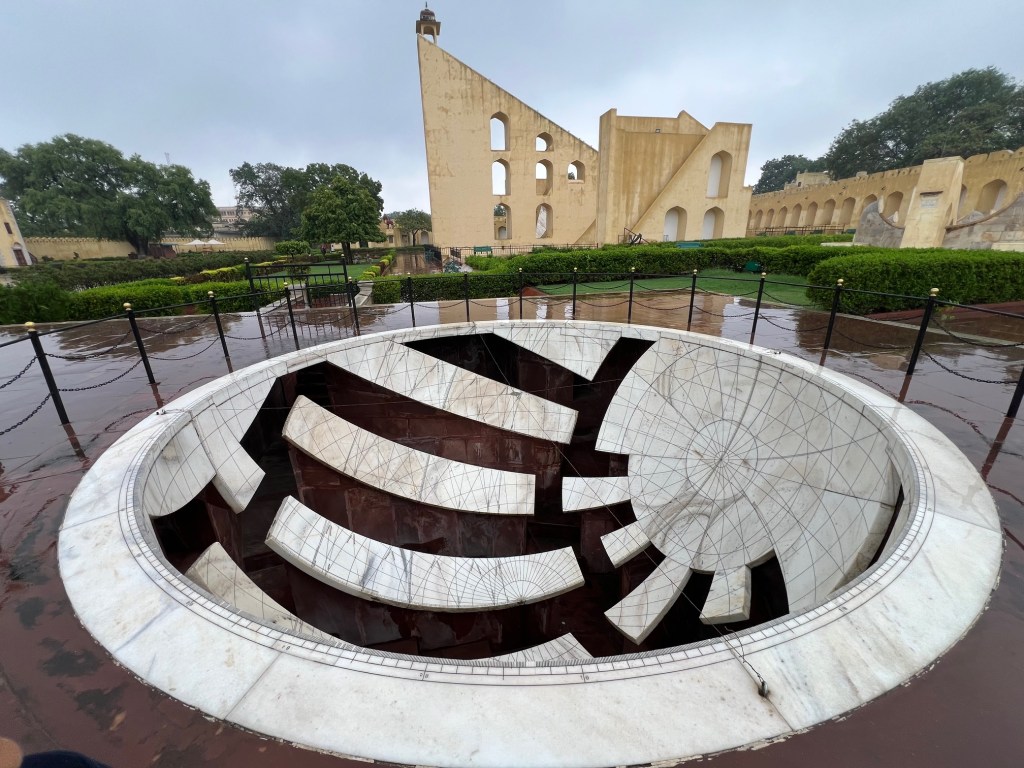
- Samrat Yantra: A giant sundial that measures time with incredible accuracy. The shadow of the triangular gnomon indicates the time of day at Jaipur. This gives the actual time at the place and might differ from the IST at Prayagraj that our watches show. At Jaipur, it can vary between 10 minutes to 41 minutes. At the time of our visit, this difference was of the order of 31 minutes.
- Jai Prakash Yantra: This instrument consists of two hemispherical bowls with staggered markings on their concave surfaces. It is used to determine the positions of celestial bodies by projecting their positions onto the marked surfaces. The usually clear winter skies of Jaipur are ideal for observing the two hemispherical segments precisely, hour by hour. The mathematical precision required to design the markings and the aperture to allow moonlight to pass through and be observed in the two hemispheres is remarkable. This design demonstrates both the advanced mathematical understanding and the artisanal skill involved in its construction.
- Ram Yantra: Two cylindrical structures open to the sky, used to measure the altitude and azimuth of celestial objects.
- Narivalaya Yantra: Comprises two circular plates, one facing north and the other south. It is used to measure the celestial latitude and longitude. This, however, was prevented from functioning to prevent mishandling.
- Chakra Yantra: A ring instrument used to measure the coordinates of celestial objects in the equatorial coordinate system.
- Digamsa Yantra: Measures the azimuth of celestial objects.
- Dakshin Bhitti Yantra: A wall instrument used to measure meridian altitudes of celestial objects.
- Rashivalaya Yantra: Twelve sundials representing the twelve zodiac signs, used to measure the celestial coordinates based on the zodiac.
- Unnatamsa Yantra: Measures the altitudes of celestial objects.
- Kapali Yantra: A hemispherical instrument used to measure the coordinates of celestial objects.
- Disha Yantra: A compass instrument used to find the direction of celestial objects.
- Dhruva Darshak Pattika: A plate used to locate the position of the Pole Star.
- Shastansh Yantra: A 60-degree arc used for measuring celestial altitudes.
- Utaansh Yantra: Measures the altitudes of celestial objects.
- Yantra Raj: A large astrolabe used for solving problems related to astronomy and astrology.
- Vrihat Samrat Yantra: An upgraded version of the Samrat Yantra, providing more accurate time measurements.
- Kanali Yantra: Measures the declination of celestial objects.
- Rama Yantra: Cylindrical structures used to measure the azimuth and elevation of celestial objects.
- Kranti Vritta Yantra: Measures the celestial latitude and longitude of objects.
Functions of the Instruments
- Time Measurement: Instruments like the Samrat Yantra and Vrihat Samrat Yantra measure time based on the shadow cast by the sun.
- Altitude and Azimuth: Instruments like the Ram Yantra, Unnatamsa Yantra, and Digamsa Yantra measure the altitude and azimuth of celestial objects.
- Celestial Coordinates: Instruments like the Jai Prakash Yantra, Chakra Yantra, and Kapali Yantra determine the celestial coordinates of objects.
- Zodiac Measurements: The Rashivalaya Yantra measures the positions of celestial objects based on the zodiac.
- Meridian Altitudes: The Dakshin Bhitti Yantra measures the meridian altitudes of celestial objects.
- Pole Star Position: The Dhruva Darshak Pattika helps locate the position of the Pole Star.
- Equatorial Coordinates: The Chakra Yantra measures coordinates in the equatorial coordinate system.
- Declination: The Kanali Yantra measures the declination of celestial objects.
- Astrology: The Yantra Raj is used for solving astronomical and astrological problems.
These instruments collectively allowed for a wide range of astronomical observations, making the Jantar Mantar a significant achievement in the field of observational astronomy.
What an Experience!
Visiting Jantar Mantar is a captivating experience. As you explore the site, you can almost feel the presence of ancient astronomers meticulously observing the skies. The site also features a small museum that provides additional insights into the history and functionality of the instruments.
Practical Information
- Location: Jantar Mantar is located near City Palace and Hawa Mahal in Jaipur, making it easily accessible from most parts of the city.
- Timings: The observatory is open daily from 9:00 AM to 4:30 PM.
- Entry Fee: There is an entry fee for visitors, with discounts available for students and groups.
- Best Time to Visit: The best time to visit is during the cooler months, from October to March, to avoid the scorching summer heat.
Conclusion
Jantar Mantar in Jaipur is more than just a historical monument; it is a symbol of India’s scientific prowess and cultural richness. It promises an enriching and unforgettable experience. So, the next time you’re in Jaipur, make sure to add this astronomical wonder to your itinerary.

