Yesterday, I revisited a post titled “Transforming Education: Navigating Challenges and Forging a Path Forward,” which discussed educational challenges in India. Coincidentally, while reading the “Times of India,” I came across an article titled “How Algebra in US Schools Became a National Flashpoint.” This article made me realize that the difficulty of engaging children in learning, particularly in mathematics, is a global issue. This warrants a thoughtful discussion and innovative solutions.
Reflecting on my own experience, I wondered, “Why should a child be interested in learning about the mysterious variable ‘x’ that seems so challenging beyond elementary school?” As an engineer, I must admit that mathematics was never my favourite subject. I only learned it because my strict parents and my grandfather, who was a teacher, insisted. They made me memorize algebraic formulas to pass exams and fulfil my father’s wish for me to become an engineer. Although mastering mathematics and clearing the UPSC exam for Engineering Services ensured a stable career, we cannot force children to learn in the same way today.
At seventy, I’ve become a writer with a passion for engaging children and young adults by sharing my life experiences. I wondered, “Can we teach mathematical concepts through stories to make them more interesting?” With that thought, I crafted a story inspired by the larger yards often found in US homes. Here it is:
A Story to Make Algebra Fun
It was a weekend and Aadit was lazing in bed when his Papa knocked on his room’s door.
Aadit: Oh Papa! It is weekend. Let me relax for a while.
Papa: I just wanted to inform you that Steeve will be here in half an hour to help us fence a garden.
Steeve was an all-purpose helper who had been visiting their house since Aadit was just two years old. He was Aadit’s buddy. Just a few days ago, Aadit’s mom had shown him a video where, as a two-year-old, he sneaked into the lower ground floor during Steeve’s lunch break and started painting the walls, making a mess. Poor Steeve had to redo the work, but he was a real support, and Aadit loved him. Their friendship became stronger as Aadit grew, so he couldn’t miss meeting Steeve. He jumped out of bed and got ready.
Papa, Steeve, and Aadit got together in their yard. Papa told Steeve to make use of the roll of fencing wire that was lying in their garage. Aadit helped Steeve measure the length of the fencing roll, which was 40 meters. Now a conversation started:
Steeve: Hey Aadit Buddy! What do you say about the garden?
Aadit: I think we should cover the maximum area using the 40m roll with us.
Papa: I agree. Now how would you go about it to ensure that you have used it to cover the maximum area?
Aadit thought for a while and said, “Well, let me think.”
Papa: Alright. Try doing it?
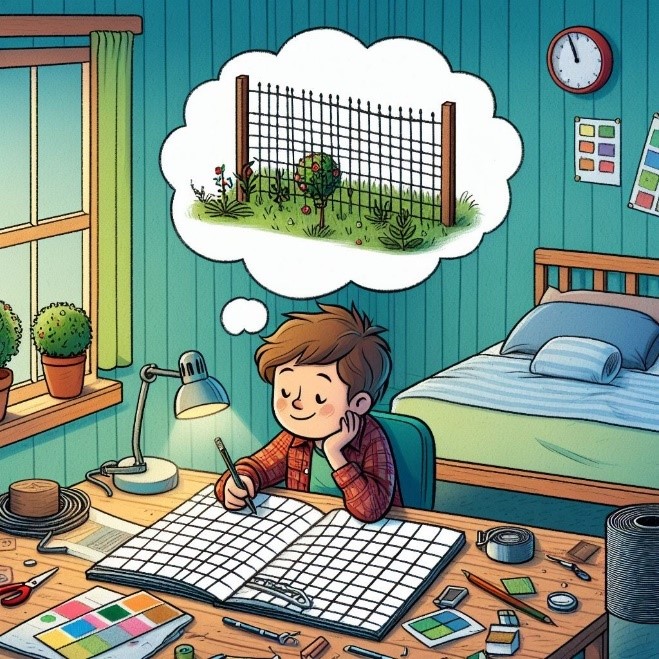
Aadit went to his room, took out his scrapbook, drew a rectangle and roll of fencing wire, and started thinking.
He could figure out that opposite sides of a rectangle are equal and the fence wire of 40 meters must cover all the sides. He thought he needed help to proceed further. He rushed down and called his Papa.
Aadit: Well Papa, I could figure out that all sides of the rectangle representing the garden, when added, should add up to 40 meters. There are two equal and opposite sides of the rectangle, and they will have to be added. So the length of the rectangle and width will have to be added twice and it should sum up to 40 meters. But how do I proceed further?
Papa: OK Aadit. Listen. Let us say you call the length ‘L’ and the width ‘B’. Taking it from what you just said:
2L+2B=40meters
Now, since the length is added two times and the width is also added two times, we write:
2L+2B=40meters
So, if length and breadth were to be added only once, what will they sum up to? Saying this, Papa wrote:
L+B=?

Aadit said: That’s easy, it will be half of 40 or 20m.
Papa: Very good! And he wrote:
L+B=20
Now Aadit, do you realize that length ‘L’ and breadth ‘B’ when added together should add to 20 meters? But there can be many combinations that can fulfill that condition. For example, it could be ‘3 + 17’ or ‘5 + 15’ or ‘6 + 14’ etc. So, till we get to a unique combination of ‘L’ and ‘B’, which when multiplied give us the maximum area, we keep trying different combinations. During this exercise, ‘L’ and ‘B’ are called ‘variables’ because their different values can fulfil the condition set forth by the equation.
Aadit: Understood Papa! How interesting! So many combinations of ‘L’ and ‘B’, the variables can add up to 20, right?
Papa: Exactly. Now can you do an exercise? Starting from a width of 3 meters and a length of 17 meters, can you work out the areas in a table and write them down? Well, to make it simple, I’ll draw the table for you.
Aadit went to his room and came back after filling the values in a table.
| Length | Width | Area |
| L’ in m | B’ in m | LxB |
| 3 | 17 | 51 |
| 4 | 16 | 64 |
| 5 | 15 | 75 |
| 6 | 14 | 84 |
| 7 | 13 | 91 |
| 8 | 12 | 96 |
| 9 | 11 | 99 |
| 10 | 10 | 100 |
| 11 | 9 | 99 |
| 12 | 8 | 96 |
| 13 | 7 | 91 |
| 14 | 6 | 84 |
| 15 | 5 | 75 |
Aadit had a careful look at the value at the last column of the table giving area.
Aadit: Oh Papa, there is only one combination for maximum area when length and breadth are both equal to 10m.
Papa: Bravo!
So, what will be the length and breadth of the garden, well it will be 10 m each to arrive at maximum area of the garden.
Aadit: Got it!
Continuing the Lesson
So What did you learn Aadit?
Aadit:
- In many day to day problems, we have to use ‘Variables’ just like ‘L’ and ‘B’ to get to a solution.
- In this case we wanted a combination of ‘L’ and ‘B’ such that we cover the maximum area of our yard in the garden.
- We tried various values of L and B and made a Table.
- From the Table, we learn that it will be 10m each for the length and breadth.
Papa: When you are dealing with variables like the above, you are using a branch of mathematics called Algebra.
Aadit: Understood Papa.
Papa: Now, let me tell you one more concept. First, tell me what happens when you multiply two numbers?
Aadit: We get a number that is many times larger. Like when we multiply 10 by 10, we get 100, and 100 is ten times larger than 10.
Papa: Very good. So when a number is multiplied two times, its power increases many times. Right. Like when 10 is multiplied by 10, its value increases ten times but its power increases two times. Like wise if I ask you to multiply 8×8, what do you get?
Aadit: Its value is 64 and power is 2.
Papa: Very nice! What if a variable is multiplied by another variable. How do we represent it in Algebra?
Aadit: ??
Papa: Well, LxL=L2 or we just put a suffix to indicate its power. Right? Now tell me what will be ‘LxLxL’?
Aadit: L3
Papa: Very good
Now in case of the garden, what did you do to find out the other side of the rectangle, when you prepared the Table?
Aadit: I subtracted it from 20.
Papa: How would you write it ?
Aadit: ??
Papa: Well if one side is L and the sum of sides is 20, the other side will be ’20-L’. Right? Now tell me if we had 80 m of wire, what will be the values?
Aadit: L and 40-L
Papa: Great
Now if we have to find this area in algebraic terms, what shall we do.
Aadit: ??
Papa: Area=Length x Breadth= Lx(20-L) for the example we did above.
Aadit: Right Papa.
So, A=Lx(20-L)
Now if we wish to write it in another form in Algebra, we have to multiply ‘L’ by 20 for the first term and LxL for the second term. We don’t do anything to the sign.
When there is a eft hand side like above and a right hand side, separated by an equal sign, it means these are equal and we call it an ‘equation’
Aadit: Didn’t get it Papa.
Papa: OK Aadit. Work out the fist term for me.
Aadit: 20xL
Papa: Good! And the second term
Aadit: LxL
Papa: What is the sign before the second term?
Aadit: -‘-‘
Papa: So, what will it be using the power I told you.
Aadit: L2
Papa: Well done! Now if you represent, the second term (20xL) as 20L, how would the two terms add up:
Aadit: 20L-L2
Papa: And what does addition of these terms represent?
Aadit: Area. We represented it by letter ‘A’.
Papa: Good! So, now write the equation with the above two terms.
Aadit:
A= 20L-L2
Papa: Very good. Do you observe something?
After carefully looking at the working, Aadit said that both the equations have the same left hand side.
Papa: Good observation Aadit. This means if you had used this equation instead of your working, you could still have got the same values of Area, you will learn about it in later class. This is one of the quadratic equation. This term is derived from a latin word called ‘quadratus’ meaning a square. We call it so because the term with maximum power of two represents a square. So now go back and write in your journal all that you learn today and come back to me.
Aadit went back and returned with this journal after 20 minutes. By that time, Steeve had finished marking the area for the garden using his spade.
Aadit’s Notes:
- Objective: We aimed to use a 40-meter roll of fencing from our garage to maximize the area of our backyard garden.
- Fence Configuration: To enclose a rectangular garden, the fencing must cover each side twice. Let the Area be ‘A’, the Length ‘L’, and the Width ‘B’.
- Perimeter Equation: Based on the above, the total fencing used is given by:
2L+2B=40 meters2L+2B=40meters
- Simplifying Perimeter: Dividing the perimeter equation by 2:
L+B=20 meters
Expressing Width in Terms of Length:
So width can also be expressed in terms of Length as, B=20−L
- Maximizing Area: To maximize the area ‘A’, we seek the best combination of L and B. Since we test various values of L and B, these are called variables.
- Side Length Relationship: Given one side is ‘L’, the other side is: 20−L
- Finding Maximum Area: By creating a table, we discovered that the maximum area is 100 square meters when both L and B are 10 meters.
- Concept of Powers in Algebra:
- A power of 2 (e.g. L2) represents a variable multiplied by itself.
- A power of 3 (e.g. L3)represents a variable multiplied three times.
- Formulating the Area Equation: The area of the rectangle can be represented by:
A=L×(20−L)
- Understanding Quadratic Equations: We learned that a quadratic equation, which has the highest term with a power of 2, can be written as:
A=20L−L2
Through this exercise, Aadit learned how to use variables, solve for maximum area, and understand basic algebraic and quadratic concepts in a practical, engaging way.
Steeve: Wow! How I wish, somebody would have taught me maths like this, I would have become an engineer!
Conclusion
Thank you for your patience. The purpose of this blog was to highlight that algebraic concepts can be made fun and introduced at the primary school level through engaging stories. This approach can help prevent ‘Algebra Phobia’ among children, not just in India, but around the world.
The author will be happy to receive feedback from the readers if they would like me to attempt writing a book with stories that demystify algebraic concepts.
 Inspire Positivity