When I was writing my latest book, “Timeless Panchatantra in Contemporary Times: Training Young Minds in Strategic Thinking,” I came across the following Sanskrit verse, quoted from the ancient scriptures in the Panchatantra authored by Vishnu Sharma in the 2nd Century BC:
न गजानं सहस्त्रेण न च लक्ष्येण वजिनां।
तत्कर्म सिध्यते राज्ञां दुर्ग्यणैकेन यद्रणे ।।
The above verse can be broadly explained as follows:
“During war, a fortress is more useful compared to several thousand elephants and hundreds of thousands of cavalries. Even if a king is singled out in a secured fortress, he can still defeat the enemy. This is why the fortress is considered so important.”
A well-designed fortress has been considered one of the best modes of protection for the king and has been used time and again in history to inflict heavy losses on attackers.
As we neared Kumbhalgarh, riding in a taxi from Mount Abu, our eyes were constantly exploring the location of the fort of Kumbhalgrah, which we thought might be conspicuous because of its location on a hill and surrounding periphery wall of 36 Kms, next only to the Great Wall of China. But much as we tried, the sight of the fort eluded us. The location of the fort was indeed cleverly planned for those days when there were no satellite imageries or GPS.
The fort is indeed unique, which is why in 2013, at the 37th session of the World Heritage Committee held in Phnom Penh, Cambodia, it was recognized as a UNESCO World Heritage Site under the group Hill Forts of Rajasthan.
On reaching Kumbhalgarh, we hired a registered guide named Mubarak to explore the fort in the short span of a couple of hours that we thought of spending had allocated to see it.
Our guide Mubarak, a Pathan by descent, told us many interesting stories. He claimed that his ancestors were employed by Maharana Kumbha who founded the fort in its present form. The thoughtful attention to the smallest detail made the fort invincible. For example, the planning of a well-guarded wall of 36 Kms wide enough for eight horses to run in parallel, the observation holes that enable only inmates to look out, the strategic location of stables, safety measures, secret escape routes to the forests of Aravali were all carefully crafted.
The unique features of this fort, as we learned from our guide and from the captivating light and sound show that followed in the evening, are as follows:
Development of Fort: It is believed that a small fort, limited to a small hilly area, was built by King Samprati from the Muarya clan in 2nd Century B.C. He is believed to be a Jain by faith. In those times, it was known as Matsyendra Durg. Later on, Rana Lakha won this entire area and plains of Godwar from Chauhan Rajputs in the late 14th century. Rana Kumbha constructed it during the period 1434-1458 CE, but several additions have been done from time to time, the last known is Badal Mahal constructed from 1885-1930 CE by Maharana Fateh Singh.
Historical Significance: holds great historical significance as the place where Maharana Udai Singh as a young Prince was brought from Chittor, as a young prince, to save him from being killed by his cousin. His governess, Panna, sacrificed her own son to protect the prince. It is also the birthplace of Maharana Pratap, one of the most revered Rajput warriors of Mewar.
It also served as a refuge for the legendary Rajput king, Rana Kumbha, during times of war and conflict. The fort’s rich history, steeped in tales of valor and resilience, adds to its allure and mystique.
Unique Features of Kumbhalgrah Fort:
- Natural Camouflage: Kumbhalgarh Fort’s positioning atop a hill amidst dense forests and rocky terrain naturally camouflaged it from potential invaders. The thick vegetation and rugged landscape would have made it difficult for approaching armies to spot the fort from a distance, thus providing an element of surprise and stealth for its defenders.
- Limited Visibility: The winding paths leading to Kumbhalgarh Fort, coupled with the hilly terrain, would have limited the visibility of the fort from the surrounding valleys and plains. This restricted line of sight would have made it challenging for adversaries to accurately locate the fort and plan their approach, giving the defenders ample time to prepare for any impending attack.
- Strategic Ambush Points: The rugged terrain surrounding Kumbhalgarh Fort would have offered numerous vantage points for ambushes and guerrilla warfare tactics. The narrow, winding paths and rocky outcrops could have been utilized by the fort’s defenders to stage surprise attacks on enemy forces, further enhancing its defensive capabilities.
- Navigational Challenges: In the absence of modern mapping technology, locating and navigating to remote forts such as Kumbhalgarh would have been a daunting task for invading armies. The lack of clearly marked roads and signage would have made it easy for travelers to lose their way amidst the rugged terrain, further complicating any attempts to besiege the fort.
Gates of Kumbhalgarh Fort
The fort was adorned with seven well-guarded gateways. Aaret Pol was the first entry gate of the fort. Halla Pol is on the downward slope from the entrance. Hanuman Pol, the next gate, is half a KM away from Halla Pol. Hanuman Pol is a double-storeyed gate with octagonal bastions. The gate got its name from the stone image of Hanuman located in front of the gate, which was brought by Maharana Khumbha. Ram Pol is the main entrance of the fort, and there is another entrance towards the east, called Vijay Pol. There are five more gates between Ram Pol to Badal Mahal, the Palace built on the highest point of the fort. Names of these gates are Bhairon Pol, Nimboo Pol, Chaugan Pol, Pagda Pol, and Ganesh Pol.
Water Conservation System
Besides above, to protect the residents during a long siege by an obstinate enemy, Kumbhalgarh fort is renowned for its sophisticated water conservation system, which includes several reservoirs adorned with a well-designed filtration system, step wells (baoris), and tanks within the fort complex. The ingenious design of these structures allowed the fort to withstand prolonged sieges by ensuring a sustainable water supply for its inhabitants during times of drought or conflict.
It is due to these unique features that the fort has remained largely invincible except in 1578 when the Mughal Commander in Chief Shahbaz Khan managed to capture it, but it was regained by Maharana Pratap in 1583. Learning from the siege by Shahbaz Khan, Badshahi Bavdi, a stepped tank, was built just after Halla Pol.
Hindu and Jain Temples
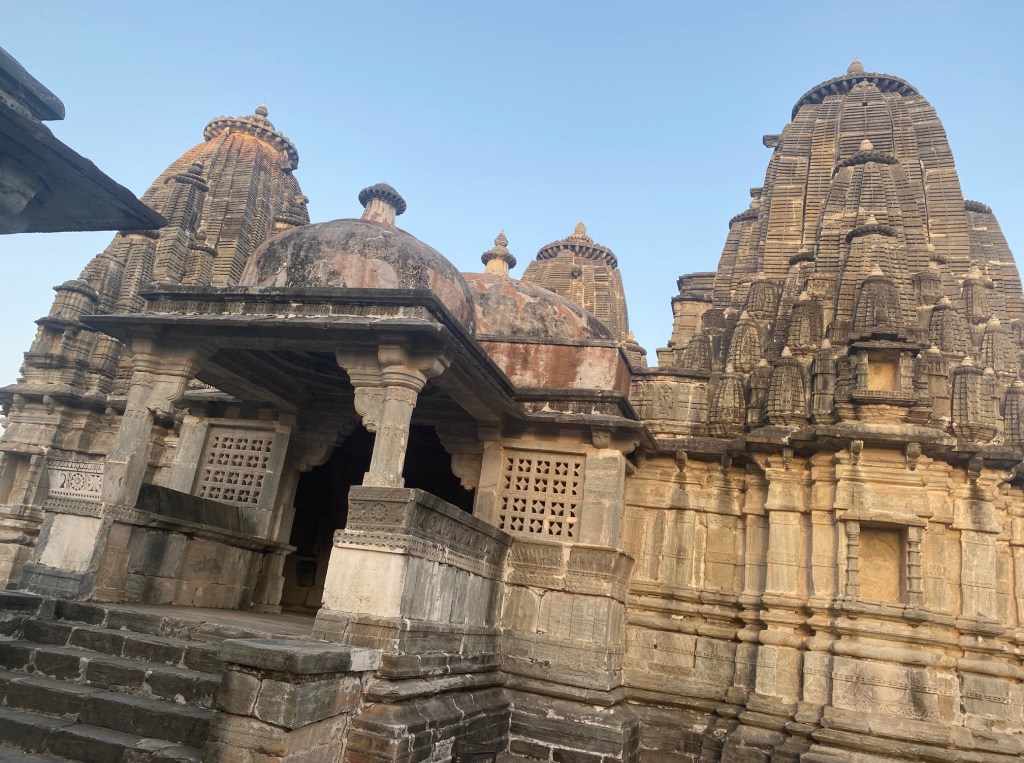
There are 360 Hindu and Jain temples within the fort complex. The Vedi Temple and the Neelkanth Temple are conspicuously noted by us. The other temples include Pasharvanath Temple, Bawan Devri Temple, Pitliya Dev Temple etc.
Architectural Splendour
Kumbhalgarh Fort showcases impressive examples of Rajput and Mewar architecture, characterized by intricately carved stone structures, ornate palaces, and majestic temples. The fort’s main attractions include the Badal Mahal (Palace of Clouds), Kumbha Palace, and the intricately carved Neelkanth Mahadev Temple, reflecting the rich artistic and cultural heritage of the region.
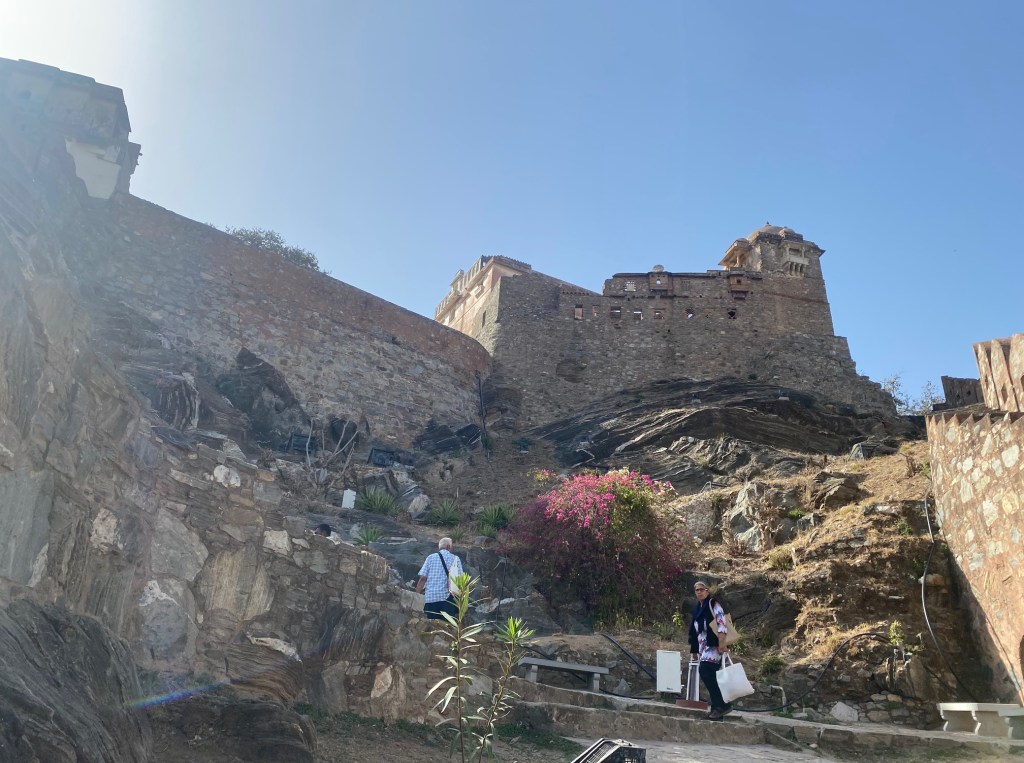
A view of the Kumbha Mahal
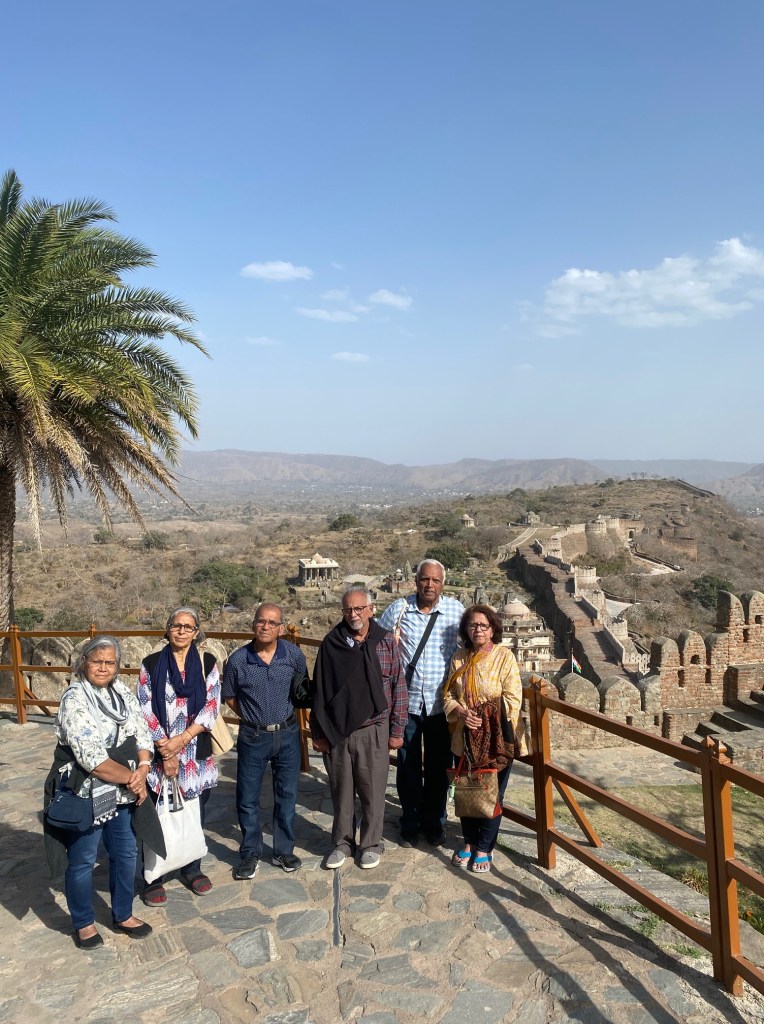
Maharana Pratap’s Birthplace in the background
Badal Mahal
We decided to concentrate on the fort and mainly concentrated on our ascent to Badal Mahal. The two storied structure has separate chambers for Queen’s and Men section. The women’s section is conspicuous by its stone carved peep hole mesh enabling the women to see and observe without being noticed from the other side. The palace is intricately decorated with beautiful paintings on the roofs and walls.
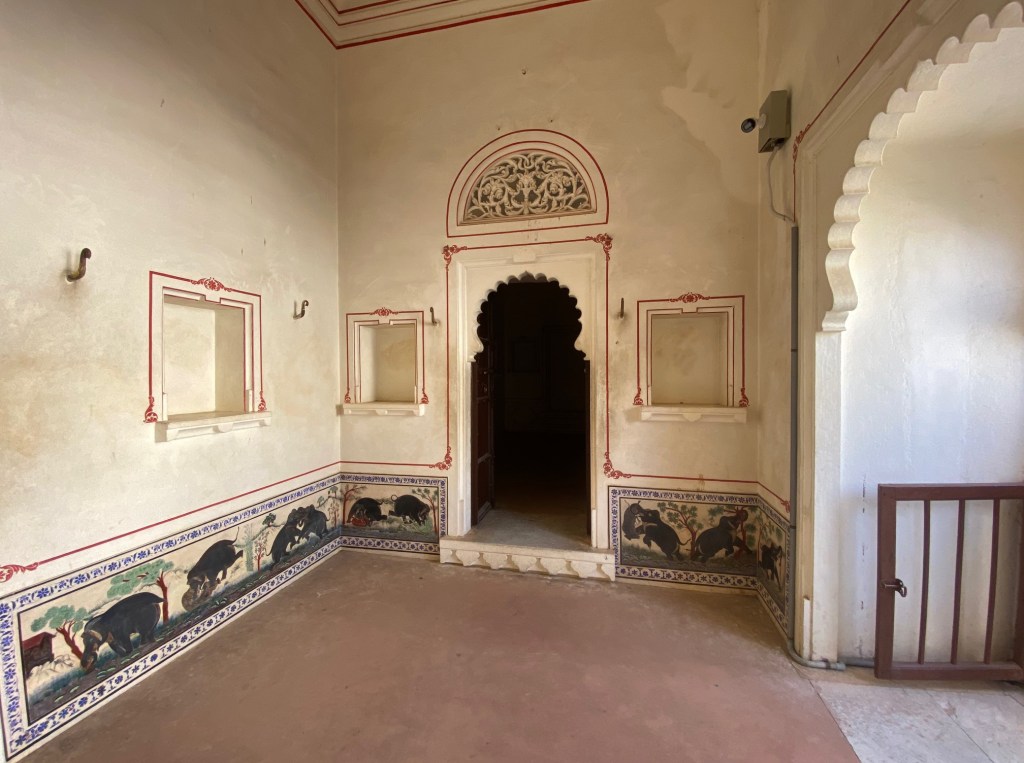
Paintings on the wall
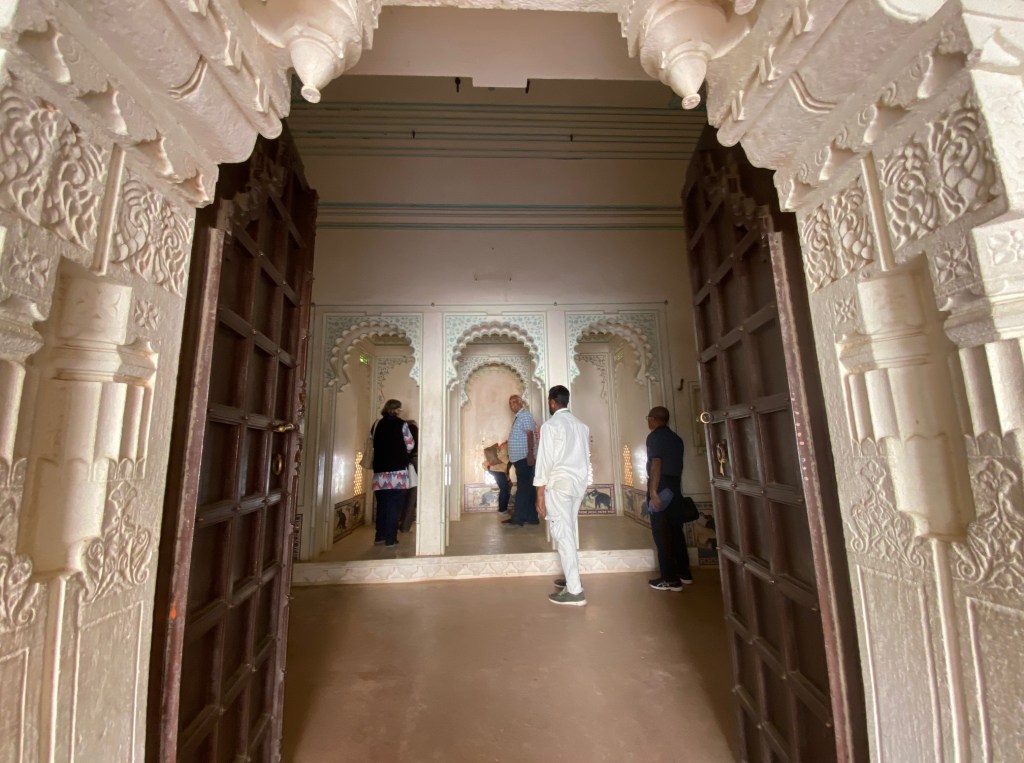
The Queen’s Chambers
Our guide took us to the places known as inner chambers of queens, where he demonstrated its intricate design, making it difficult for an external person to hear a secret conversation as well as the possibility of calling for help with a clap.
The Light and Sound Show
The forty-five-minute Light and Sound show that narrates the story with the fort itself as the protagonist is not to be missed. During the show, various parts of the fort are lit beautifully and highlighted with captivating commentary.
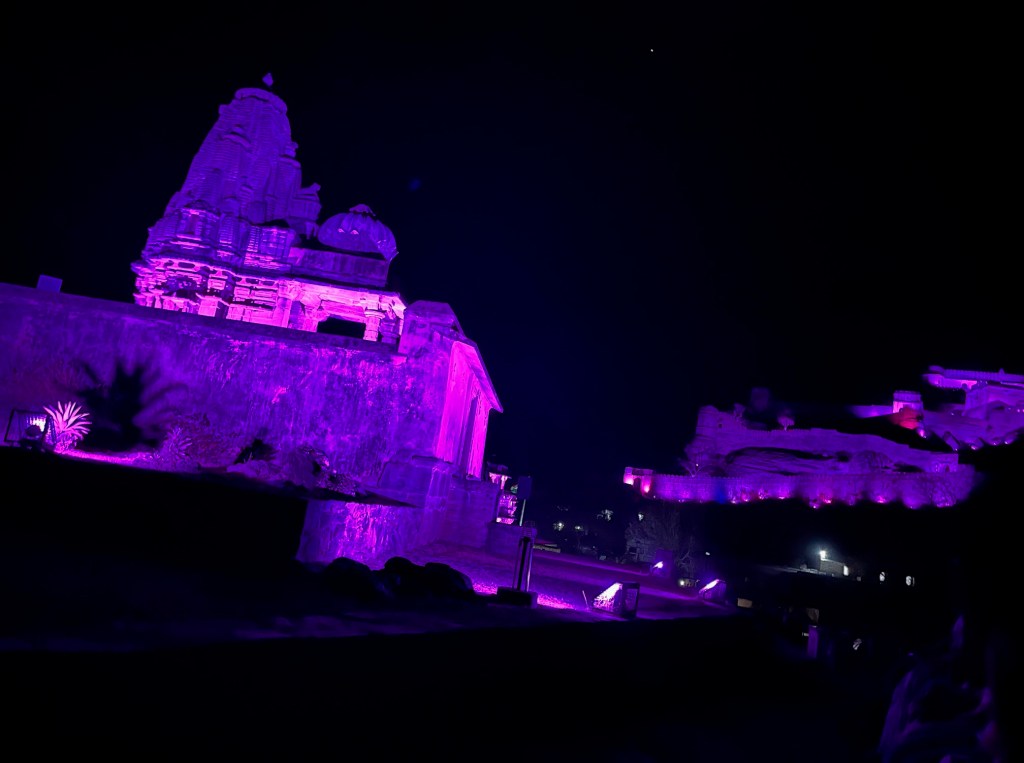
Taken during the Light and Sound Show
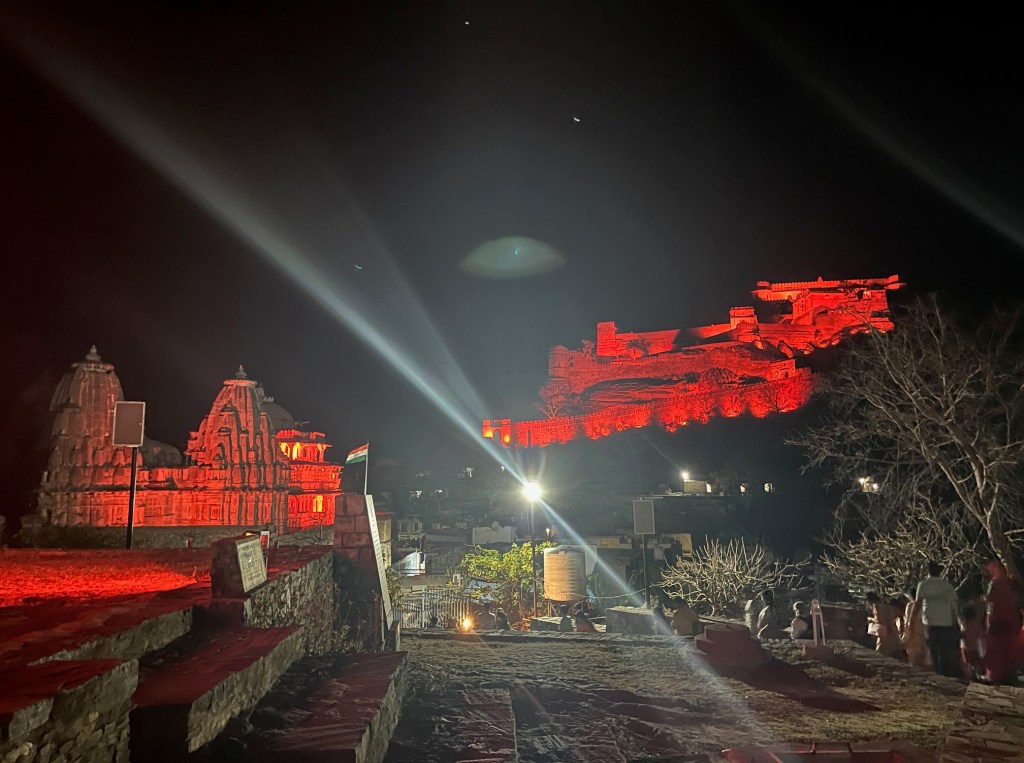
Taken during the Light and Sound Show
Travel Recommendations
To reach Kumbhalgarh, travelers can embark from either Mount Abu or Udaipur, depending on their travel plans. However, it’s essential to arrange transportation beforehand. Our group, comprising three senior couples, opted to travel from Mount Abu. Spending a night in Kumbhalgarh proved to be a wise decision for us. I highly recommend experiencing the serene beauty of the Aravalli ranges by staying overnight at one of the resorts. Our stay at Kumbha Residency left us enchanted, immersing us in Rajasthani hospitality and vibrant folk dance performances.
Kumbhalgarh Fort offers a plethora of historical marvels that can captivate history enthusiasts for days on end. While a week-long exploration is conceivable, I suggest a minimum stay of one day to truly absorb the fort’s grandeur.
Visitors should be prepared for some walking and exploration within the fort premises. It’s worth noting that the stairs leading to the exterior wall lack railings, and some are worn out. Exercise caution while ascending the wall to ensure a safe and enjoyable experience.
For a deeper understanding of the fort’s intricacies, I recommend hiring a knowledgeable guide. Their insights can uncover hidden gems and enrich your exploration, providing a deeper appreciation of Kumbhalgarh’s historical significance.
 Inspire Positivity